skip to main |
skip to sidebar

 I'd like you all to meet Walter. Walter is one of the kits born Dec. 31st here on the farm, and one of only two still at the house. The rest have all found homes. Walter enjoys sunflower seeds, apple slices, harassing cats, and running on carpet as fast as he can.
Walter is possibly going to a new home this weekend (hope I don't jinx it!), just in time for Easter, but we are now assembling a list of interested parties for our next litter, soon to be bred of Sadie by Fritz. To be added to our mailing list, please send a message to our new rabbitry email address. We shall miss his sweet face but wish him the best!
 Although you can just stick your bunny's hay anywhere in the cage, the use of a hay rack of some sort will keep the cage looking tidier and result in less hay spoilage. Hay on the floor often collects debris. They will often pull hay out of a rack, but even so much of the hay stays clean longer, and of course that also gives them an extra entertainment.
 There are special hay racks and whatnot sold by various pet and livestock supply companies. We find, however, the easiest thing is a Closet Maid packet rack. These are available at Home Depot and most likely online for just a few dollars. If you have bunnies that like to pull the whole rack down and flip it over, you can secure it in place with a plastic zip tie or metal snap.

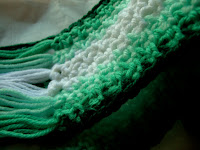
 Folks all over the East coast have been enjoying a bout of snowy laziness, the likes of which we haven't enjoyed since 1996. I know for some, lack of stuff to do eventually leads to the dreaded Cabin Fever, characterized by boredom, restlessness, itchy fingers aching for stuff to do, and general cranky behavior. In an effort to help your recovery, I'm posting a free crochet pattern (or really, design guide).
For this scarf, start by raiding your stash. Pull out partial balls of yarn leftover from various projects, or small balls of handspun. Match up complementary colors and textures, and go! This project is meant for instant gratification.
DESIGN GUIDE:
- Any yarn, any gauge, any width, any length. Can be a short scarf with buttons or a pin, a very long scarf with fantastic fringe, or even a shawl.
- With hook size appropriate for yarn (check label, or just test a few), chain the length of your scarf/shawl loosely. Honestly, it's a lot to count, just gently chain away until it "looks about right". The beginning chain will be the lengthwise center.
- Of the examples you see, two are made with Red Heart Acrylic yarn leftover from afghans, the third is Lion Brand Homespun from various projects. The beginning chain is in the center of all of these. Color progression details are as follows:
- Blue/Brown: Foundation chain, blue. 5 rows blue. Flip. Starting at foundation chain, 5 rows brown.
- Green: Foundation chain, White. 2 rows white, 2 rows mint green, 2 rows medium green, 1 row forest green. Flip. Starting at foundation chain, repeat color progression.
- Homespun: Foundation chain, raspberry. 1 row raspberry, 1 row cream, 2 rows aqua, 1 row cream, 2 rows raspberry. Flip. Starting at foundation chain, repeat color progression.
- Stitch Pattern:
- First row - Skip first Ch, SC in next 3 ch, *Ch 1, skip one ch, SC in next Ch, repeat from * across to last 4 Ch, then SC in last 4 Ch. If the number of chains is off by one, fudge it by SC twice in one chain. Don't cringe, it is just a quickie scarf - it'll be fine. Mark this side as "front" with a piece of scrap yarn or safety pin.
- Next row (change color if desired) - Ch 1, SC in next 3 SC, *Ch 1, skip next SC, SC into next Ch 1 space. Repeat from * across to last Ch 1 space. SC in that Ch 1 space as normal, then SC in last 3 SC (makes 4 SC in a row).
- Repeat last row, changing colors as desired, until half desired width is reached.
- Flip scarf, returning to foundation chain. Make sure that the "front" is facing you. Attach yarn, Ch 1, SC in back/unused loops of next 3 Ch, *Ch 1, skip next SC space, SC in next unused Ch space, Repeat from * across to last Ch 1 space. SC in that Ch 1 space as normal, then SC in back/unused loops of next 3 Ch (makes 4 SC in a row).
- Next row (change color if desired) - Ch 1, SC in next 3 SC, *Ch 1, skip next SC, SC into next Ch 1 space. Repeat from * across to last Ch 1 space. SC in that Ch 1 space as normal, then SC in last 3 SC (makes 4 SC in a row).
- Repeat last row, changing colors as desired, matching or not matching other half as preferred, until desired width is reached.
Enjoy!
For other knit & crochet patterns, please see my pattern page or find me on Ravelry as SapphireChild.
 Fritz says, "Oh dear heavens, what have you done to me!?"
To see what Fritz looks like in full coat, click here.It was time for Fritz to be sheared. As always, he looks horrible now. I generally go for the quick haircut, rather than the stylish approach. We use a pair of rounded tip scissors, like you might buy your kid to cut construction paper with. Since they're not pointy, I won't accidentally stab him if he suddenly decides to make a break for it, and since they're not razor sharp, I'm not likely to cut skin with it (again, if he suddenly moves or something). We do this about every three months, with periodic combing and checking for mats in between. Since it is currently cold in our unheated bunny basement, I didn't clip him very close.Some folks also use electric clippers for their buns. I understand that there are special brands designed specially for rabbits, but as I'm to cheap for that I can't advise you on it.Keep in mind also that some angoras shed or molt naturally every 3-4 months. Usually such bunnies are double or even triple coated, so that even though the outer hairs are shed, there is still a full coat underneath. The mom of our recent litter does this. She is a French angora. When they are in molt, you can gently pluck the already loose hairs.
The following is a snippet from a NY Times article:
Located on a 45-acre estate in Newport, Rhode Island, SVF is the only organization in the country dedicated to conserving rare heritage livestock breeds by freezing their semen and embryos.
About 45,000 semen and embryo samples from 20 breeds of rare cattle, sheep and goats are preserved there in liquid nitrogen. Each time the foundation freezes a batch of embryos from a new breed, it thaws a few and transplants them into surrogate animals.
While commercial livestock have been bred for consistency, heritage breeds have not been continuously "improved" by humans. They have been shaped more by natural selection and survival-of-the-fittest forces. They are a valuable resource to the livestock industry.
Before SVF, the preservation of heritage livestock was through natural reproduction and organizations like the American Livestock Breeds Conservancy.
Read full article in New York Times As a fan of heirloom plants, unique characteristics and genetic diversity, this piques my interest. Line bred plants and animals are for commercial farms. They're boring but predictable. They can be high output and uniform, but can also be rather demanding for feed and maintenance. Small farms and home growers have the opportunity to work with something more interesting and unique and self sustaining in heritage breeds and heirloom plants.Looking further into the American Livestock Breeds Conservancy, I find they also have several rabbit breeds listed. These are mostly rabbits originally selected for fur and meat, so not the true "naturally selected" hardy breeds I would consider heritage, but they are endangered as rabbits have fallen out of favor for fur, and though they are still bred for meat by some it is on a small scale only. Angoras, of course, are still kept and bred for *wool*, not pelts, but obtaining and propagating these heritage breeds, as well as careful interbreeding with angoras, may produce some lovely wool rabbits with hard to obtain color and different textures while improving genetic diversity of the angora. Of course, if you have space, you'll also want to help keep the heritage breed itself going, but by at least obtaining a kit from a breeder support is provided for those dedicated to the breed.
Something to think about.

 Sorry for the fuzzy photos here, folks. Can't seem to get the knack of photographing constantly moving bunnies. These photos were taken a few days ago (at 15 days). Over the past week they've been increasingly mobile, advancing from crawling to a little hopping. They groom and snuggle with each other still, and although they're still nursing they're also eating a little hay now. Good thing too, because mom occasionally give them the hairy eyeball- they have teeth now. We get them out at least once a day to handle everyone so they get used to it, but because they're young they go right to sleep as soon as we put them back. They're very cute.Thought I'd talk a little about cages. Even if you're going to keep a bun as a housepet, he'll still need his own spot. They're good at getting into all kinds of trouble, such as chewing on cords along with an assortment of other troubles, etc, so its generally a good idea to both bunny proof and also keep your bun in a cage or pen when you're not at home. The cage will also be where the bun's litter box and food is kept. Primarily I'm going to talk to the house rabbit owner here, with one to a few rabbits.At a minimum, I'd suggest a cage 36" long x 30" high (to allow "periscope" room for your bun to sit up and look around) per rabbit. Bigger will of course be appreciated, especially if the critter will be cage bound. You can find rabbit cages in the pet store, but I feel most styles are too small for French or German Angoras as they are average cat size. There are also an assortment of other types of commercial cages you can order online.
 An easy cage to use is a dog crate. Dog crates with plastic tray bottoms are great. You can find them at the pet store, online, new or used. You can also modify them to have a suspended floor of hard wire cloth if you're not litter training. Fritz here (the little 'bits' dad) lives in a dog crate. You can see his littler box and hay rack (which is actually a spice or small item rack that works with modular pantry shelving) in the back there.
Look for a 36-48" crate with a removable plastic bottom (makes cleaning easier!) and a door on the long side and top for easy access if you can find it. Fritz' cage only has a door on the short size, which is ok, but that means sometimes I have to lean into the cage to clean or grab things. Sometimes crates are tall enough to build a second level perch if you like. Here's a really fantastic modified dog crate cage. Depending on your household, you may also find it acceptable to simply designate a bunny corner and use a dog exercise pen to contain the bun when you are not around. If you go this way, though, get the tallest one you can find. French angoras are spectacular jumpers. Go for a pen that is a minimum of 3 feet high, and/or get some extra panels to make a lid for the pen (especially if there's a hidey box inside the pen - they'll hop on top and over). You can also build a rabbit condo. A really popular method is with the collapsible wire storage cubes, as it uses readily accessible materials and can be done with no woodworking skills. Here are several websites to get your creative juices flowing:
How to build a rabbit condo (with YouTube link)
Ed and Beth Bunny condo tutorial
Awesome gallery of home-made wire cages
There are lots of other cage styles that you can build with a few basic woodworking skills. Here's a different approach. I also recently saw a multilevel cage made from a cheap wood shelving unit. If you have the skills, have fun with it!

 I'd like you all to meet Walter. Walter is one of the kits born Dec. 31st here on the farm, and one of only two still at the house. The rest have all found homes. Walter enjoys sunflower seeds, apple slices, harassing cats, and running on carpet as fast as he can.