Sunday, March 13, 2011

Frozen Blueberries and Creatively Dyed

I've been working off and on with 2lbs of a 75% Coopworth wool, 25% Bombyx silk roving, and it was dragging on and on. I finally got over my motivation issues with it and finished up the lot, yielding an estimated 1200 yards of worsted to heavy worsted, 2 ply yarn. It was spun in the supported long draw style, which worked well with the fiber. I think I'll knit a nice beefy and heavily textured coat style cardigan with it, perhaps cables, but we'll see what actually happens when I actually start working with it.

Almost as soon as the wool/silk was off the wheel, I started working on this Creatively Dyed 50% Merino, 50% Bamboo braid (4oz) that I bought a few years ago at a fiber festival. I've shown here for you photos of the fiber, the singles on the wheel, and the finished and washed yarn. I chose to spin at a higher ratio with the single looped across the flier arm to reduce draw in rate and increase twist in order to reduce the grist of the single. The fiber was split in half-ish, spun on seperate bobbins, and the two plied together. I obviously either didn't split it right or the singles overall were not the same and also seems some of the color blocks do not go all the way through the roving section, so there was variation in the plied yarn and the colors did not match up perfectly. However, I am very pleased with the overall result. There is a large section of green, and the rest of the yardage is varying shades of copper, warm yellows, peach and a touch of purple. It is approximately fingerling weight.

At the moment, I'm planning to knit the Ginkgo Shoulderette Shawl by Fragrant Heart Creations.

Sunday, March 6, 2011

More Gluten Free Cupcakes


I don't know what to call these muffins, but just like the last recipe I shared, they're going to indulge the lazy side of the gluten free chef as they're based on a cake mix. But that makes them no less awesome, I assure you. These disappear at record speed. Here's what you'll need:

* 1 bag Namaste Foods, Gluten Free Vanilla Cake Mix
* 1/2c oil - I used about 3tbs butter and filled in the balance of the measuring cup with coconut oil
* 2oz (Approx.) cream cheese
* 3 large eggs
* 1/2c (Approx.) Pecans
* 4 - 5oz (Approx.) Chocolate chips
* Dried cranberries (I get these from the co-op, but "Craisins" might work as well)
* Macaroon coconut for topping

Heat oven to 350*F, as directed by the mix package. Put paper liners into muffin pan (I prefer a stoneware pan for nice, even baking).

Chop or grind pecans to taste. I usually pound them into powder, but if you prefer chunks, that's fine too. Set aside.

Soften cream cheese, butter, and coconut oil briefly in microwave, but be careful to not overheat them or they'll cook your eggs. Mash up then whip with the eggs. Add cake mix and pecans gradually, mixing after each addition.

Add chocolate chips and/or dried cranberries, as desired, and mix.

Portion into miffin/cupcake tins. I usually fill about 3/4 full or so. Sprinkle coconut on top. Bake 20-25 min until a toothpick comes out clean. Remove from pans and cool muffins until cool enough to eat without burning your tongue. Enjoy.

Makes 24+ muffins.

Saturday, February 12, 2011

Gluten Free Pumpkin Spice Muffins


Mmmmm....super yummy by themselves or with a cream cheese or peanut butter topping, these muffins are easy to make since they're based on a cake mix. I just made a few modifications to the mix instructions. Here's what you'll need:

* 1 bag Namaste Foods, Gluten Free Spice Cake Mix
* 3 large eggs
* 15oz can pumpkin puree
* 2.5oz (Approx.) cream cheese
* 2tbsp (Approx.) Blackstrap Molasses

Heat oven to 350*F, as directed by the mix package. Put paper liners into muffin pan (I prefer a stoneware pan for nice, even baking).

Soften cream cheese in microwave, mash it up then whip with the eggs, pumpkin, and molasses. Add spice cake mix gradually, mixing after each addition. It will be thick. Resist the temptation to add additional liquids.

Portion into miffin/cupcake tins. I usually fill about 3/4 full or so. Bake 25-30 min until a toothpick comes out clean. Remove from pans and cool muffins until cool enough to eat without burning your tongue. Enjoy.

Makes 22-24 muffins.

General comment about Namaste Gluten Free baking mixes: They're awesome. Some of you might have been excited when Betty Crocker came out with Gluten Free mixes. I have to say, I really wasn't. I'd already fallen in love with Namaste. They're made with quality, whole food ingredients.

We also highly recommend their Gluten Free Pizza Crust Mix.

Saturday, February 5, 2011

Suggestions for Success and the Pea Vines Shawl


Thought I'd show you all a recent finished object today. This is my rendition of Anne Hanson's Pea Vines Shawl. You can also view/buy this pattern directly on Ravelry. I have made the medium size shawl with Knitting Notions Merino/Bamboo in Azure. I had a little trouble - I only had one skein and it wasn't quite enough. But Katherine at Knitting Notions was very helpful in finding a skein of the same dye lot for me, and I was able to finish it with no modifications. Thanks bunches Katherine!

The design is well presented and interesting work. The main body of the lace work with the little nupps creating 'peas' is a little complicated, so maybe not the best for your first lace, but if you're past that beginner stage and comfortable working from charts, it is a fairly straightforward pattern to follow. It also has written instructions, for those of you crazy enough to not like charts.


I have three suggestions for you that might make the process easier.

First, as the shawl is started from the bottom, necessitating a lot of casting on, here is a simple way to make sure you have enough yarn to cast on all those stitches:
Cast on a sample by long tail. Note how many stitches wide your sample is for reference. Knit a bit. Check your gauge and they type of fabric produced. Carefully rip out, but when you get to the cast on edge, pinch the tail in your fingernails right where it joins the fabric edge and hold on. Rip out remaining stitches, leaving the slip knot in place. Without stretching or allowing sag in the yarn, measure the length of yarn between your fingernails and the loop. Divide this distance by the number of stitches used in the sample, then multiply by the number of stitches you plan to cast on, and add 10 or 20% of the distance, then measure out this distance on your yarn and tie a slip knot. Cast on. Rejoice that you only had to do it once.
HOORAY.

Second, I find nupps, at least the style Anne has used for this pattern, easier to create with a steel crochet hook, both for the making of loops and pulling through of the last. Try it - cuts down on the swearing.


Third, as suggested by another Ravelry user, I stuck a T-pin under/at the base of each pair of peas during blocking (see photo), to encourage them to pop out a bit. For the medium size shawl, you're going to need a lot of pins for this, maybe 75 or 80.

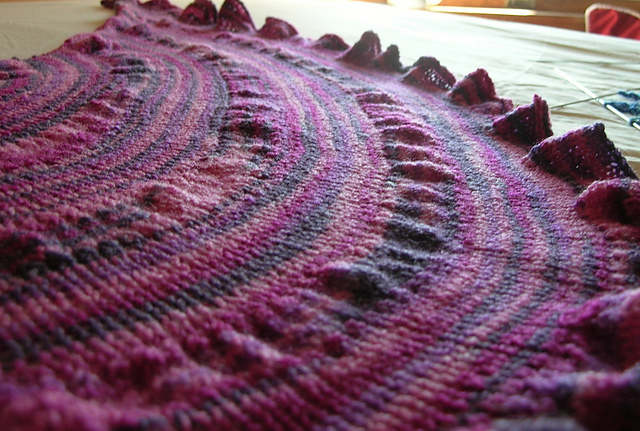
The last image is of the unblocked shawl. I remember hearing Kelley Petkun of Knit Picks saying in a podcast once that she would like to see more folks post images of their unblocked lace, so that the uninitiated to lace can see how different the final product looks from the in process item. See how scrunched up it is vs the photos posted at the top of this story? As you might guess, the blocking and stretching process also causes the shawl to grow considerably in size.

Sunday, January 23, 2011

Bunneh in Repose

Rosalind, taking a break.

Empire's Rosalind hybrid angora rabbit

She was shorn just before Christmas, below you can see exactly how poofy she was prior to her haircut. I haven't listed it on Etsy, but I could be talked out of her fleece. The clip was 4.5oz prime fiber this time.

Empire's Rosalind hybrid angora rabbit

Sunday, January 2, 2011

Customer Appreciation: Kate's Scrumptious Handspun


I was most gratified recently to get some lovely feedback from an equally lovely customer, Kate, in the form of two tempting photos and some comments on some of the roving I have available. Above, you'll see Kate's handspun made from the Coconut Truffle swirl roving. Doesn't her yarn look utterly squeezable and yummy?!

Here is what she had to say about her experience with the roving:
I'm just a brand new spinner working with some really nice fiber. I must say that the [roving] is extremely easy to work with and we all liked the effect of the blend. I think using this provided the "ah-hah" moment I was waiting for - when it all pretty much started working the way it was supposed to.
I'm just tickled to hear that she enjoyed it and even more excited to see the photos of her yarn. I have enjoyed my various conversations with Kate, as well, and hope to have many more. Thanks for your feedback Kate!

Sunday, December 12, 2010

Exploring Houndstooth Patterns

Houndstooth is generally woven as two colors in a twill pattern, alternating groups of 4 threads of each color, creating sort of color drag across the fabric rather than discrete checks. In plain weave, which is the easiest and most typically used texture when weaving with a rigid heddle loom, you can make some thing very similar looking by using just a 2x2 check. Here are two scarves woven in just such a way. For my fellow crafters, I've included some commentary on the yarns used. Both were woven with a 10 dent heddle.

First - Gray Area Houndstooth
55% Bamboo, 35% Wool, 10% Angora


Fabric is fabulously dense yet drapes luxuriously, and displays a slight aura from the Angora. It feels absolutely divine in hand.

The yarn used here was Paton's Angora Bamboo. The yarn sheds a bit in handling, but not excessively so - it does have some angora in it, after all - and otherwise has a nice solid feel. It is ‘toothsome’, like al dente spaghetti, if you’ll forgive the comparison. However, of the 4 balls used, 2 had splices in the form of enormous knots, which would have had to be cut out even in knitting they were so bloated.

It did not fuzz out as much as I expected with the angora, I suppose the bamboo keeps it in line mostly. Yarn held together nicely during washing, displaying no fraying, so the fringe was left loose.


Second - Dreamsicle Houndstooth
50% Silk, 25% Cotton, 25% Rayon


Please forgive my camera, it thinks this is far more toward red than it is in person. Actual color is closer to the color of a clementine's peel, perhaps a hint darker.

The fabric has a comforting weight and smells pleasant due to the natural fragrance of silk. The yarns are neither soft nor scratchy nor slick. The feel is more..."rustic". It was woven with the idea of a solid but not overly insulating spring scarf, but may also be at home as a table runner.

The yarns are slightly different in grist as well as texture, making the orange squares stand out a bit. It turned out very well. It was a delight to weave, both for the textural and color interest, and also for that lovely smell of silk.


The yarns used were Svale Dale of Norway/Dalegarn (white) and Shibu Ella Rae (orange). I have knitted with the Dale of Norway, and it is of very 'splitty' cabled construction with very little give. It has poor twist and is rather stringy, in fact. Weaving with it is fine, but due to the structure, or lack thereof, the fringe had to be twisted to prevent unraveling.

By contrast, Ella Rae has nice construction, with a puffy rustic feel, and a lovely natural fragrance as it is 90% silk. I suspect it would be nice to knit with, though I have not tried. Loose ends unravel only slightly after washing.

I very much liked weaving the 2x2 structure with the differently textured yarns, and would highly recommend trying it to all my weaving friends. It makes for a very interesting fabric.

Sunday, December 5, 2010

Finished: Silken Tulips


Although this has been off the loom for a while, I often procrastinate finishing details like washing/blocking and neatening fringe. This particular scarf, first posted about here, came off the loom November 6th. Somewhere along the way, I washed it, but only applied finishing details (trimming and twisting the fringe) this weekend. Now that it is completed, I'm able to realize how much I like it. In the beginning, I was on the fence, because the white wool/silk warp wasn't really what I had in mind. I wanted something darker, more mysterious. What I got was very Spring-like. But it works very well.


The fabric is light, despite the long length, with lovely drape and a soft, pleasing hand. The plump twisted fringe is delightful. But what really makes it is that wonderful painted warp look. I even love the way the fringe is differently colored.


Overall, the fabric is approximately 58% Merino, 30% Tencel, 12% Silk, and it might show out better if I were to press it, but I really hate pressing things for one, and for another, if it doesn’t sell at my show this week I think I might just keep it. So… no sense in tarting it up more than necessary. :P

Tuesday, November 23, 2010

What to do with your swatches

We all know we're supposed to knit a swatch (and wash it) before starting a project, especially big ones. Whether we do or do not actually follow this protocol is another matter. Shown here is a swatch of alpaca in the lace style before and after washing. It was not stretched or blocked, just washed and laid out flat to dry. This was my test for the Memories of Ukraine tunic sweater found in The Natural Knitter (good book, by the way, excellent photography). Notice the difference in the fabric. I'll admit, I don't always swatch when working with a bounce-tastic wool, but with alpaca it is a must.

But once you're done with a project and you no longer need the reference or extra yarn, what do you do with that swatch? More solid swatches are often used as coasters in our house. You could also turn them into squishy blocks for toddlers, or felt them and sew a bunch together for a bag or trivet, or sew up a single felted swatch with some stuffing and catnip for your felines.


Or you could just make a sweet pink-cape-of-doom for your freezer bat.

Saturday, November 20, 2010

Joyce Jr


This baby blanket was finished and gifted this week, after what felt like forever knitting it. In reality, I finished it in about a month. But I was eager to be done with it because although the finished product looks awesome, it wasn't exceptionally entertaining to knit being garter stitch and simple black and white color. It also turned out rather enormous, and had I actually been paying attention I would have skipped the last two bands of color. But I just followed the pattern blindly.

The pattern is OpArt, published in Knitty, modifying only the increase method to knitting up from the bar between stitches. We chose to do the black and white version because the recipient is not interested in pink. Also black and white have the advantage of being the first colors babies can differentiate, meaning this blanket may offer hours of entertainment for the little one.

As it is knit in acrylic for easy care and hard wearing durability, I chose not to attempt blocking it into a square. Acrylic doesn't take well to what would be required for that and the house would end up smelling like burnt plastic. Besides, I like the curly-Q edges.

Sunday, November 7, 2010

Sweet Peas and Celestial Alpaca


Due to procrastination, the following two shawls have been completed and off the needles for some time, but I only just this weekend washed, blocked, and photographed them.

The first is a Citron, modified for length to accommodate not-quite-enough yarn, knit with Knit Picks Gossamer, which is lace weight merino that has been discontinued. Its a nice, squishy yarn, and this particular pattern is just the sort of thing that's great for a high-contrast multicolor yarn. Too much structural detail can get lost in the activity of the colors, but this pattern seems to work it. I've shown here the yarn for comparison and a clip of the finished shawlette. Size of the finished object is smallish, but enough to use as a colorful scarf.

Also blocked today was my take on the Celestial Trio pattern, using a boutique DK Alpaca yarn I purchased several years back at the first MD Sheep and Wool Festival I attended. - Totally worth attending, by the way, biggest festival of its kind I hear, with attendance in the 10's of thousands.


Both patterns are based on pi shawl shaping, and both are well written and easy to knit. The pi shawl style I believe was first introduced to knitting literature by Elizabeth Zimmerman in Knitting Around. This is a highly recommended book, as are all of EZ's books, by many knitters. She is well known for her preference to teach knitters to knit and think on their feet, rather than regurgitate pattern directions (not that there's anything wrong with that, it just limits you a bit). She's also rather entertaining.

Sunday, October 24, 2010

Weaving Drama


I recently started a new project on my rigid heddle loom. Actually, I warped it several weeks ago, then drama and procrastination ensued.

The photo above gives a serviceable view of the warp colors, which is a hand dyed sock yarn (50% Merino wool, 50% Tencel) from Spinning Bunny. I've had this a while, I'm not sure what the colorway was or if she still makes it, but it is pretty close at least to the description of butterfly bush. Also I tossed in a few stands of some blue leftover from a lace project. Working very carefully, I direct warped the loom across my living room pulling and tugging mercilessly on the yarn to keep the color changes relatively even to form a 'painted warp' look.


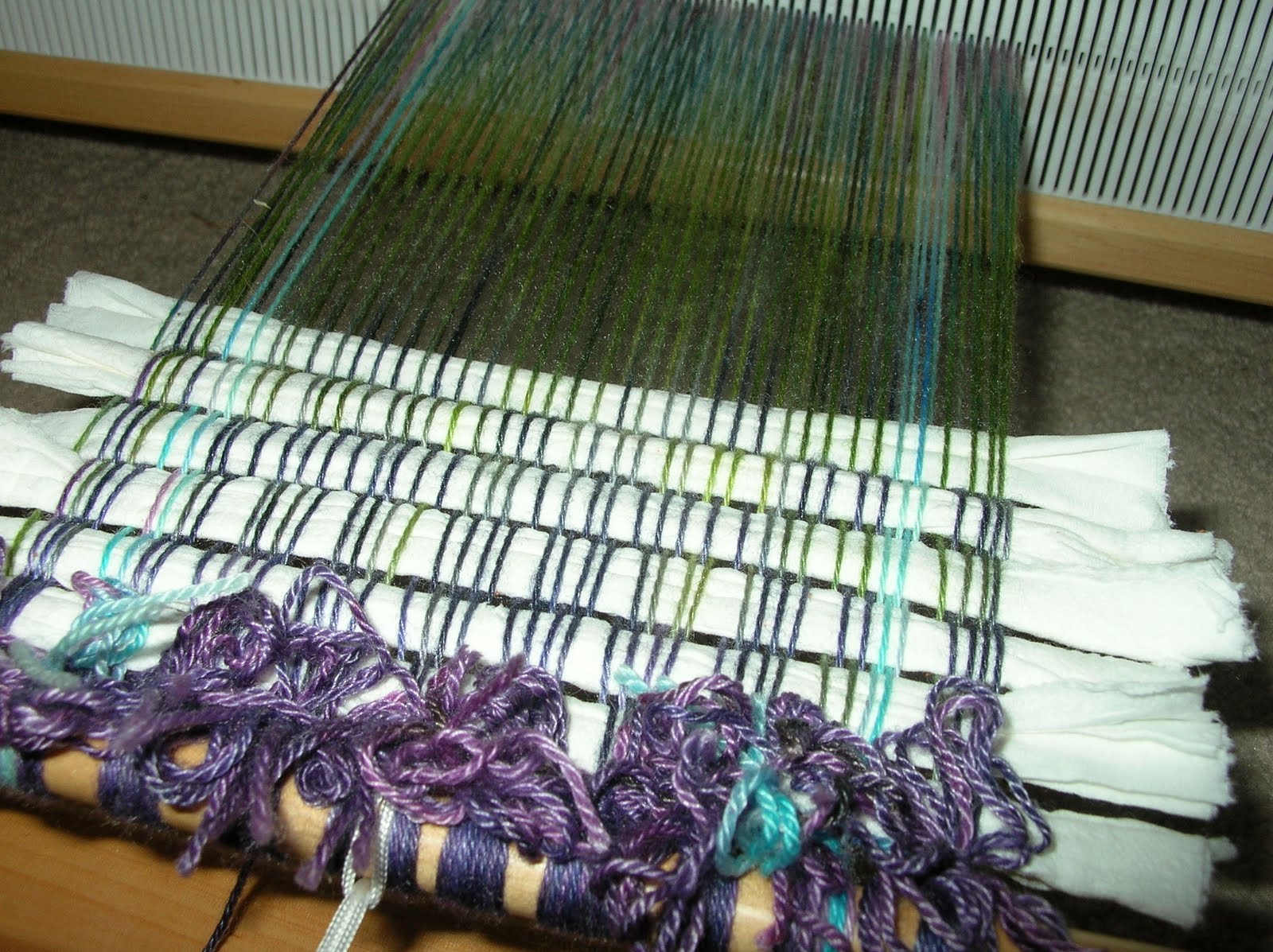
This photo was thrown in because of a recent discussion about using folded paper, paper towels or toilet paper instead of waste yarn to even out the warp and get the project started. Paper products are easier to get out later than scrap yarn, and they don't tend to leave presents behind (waste yarn likes to leave things like bright red acrylic fuzz). Paper products => better house-trained.

Anyway, back to the drama. The loom was warped through a 10-dent heddle and I began weaving with a dark blue Merino/Nylon yarn from Knit Picks. I wanted it to be dark and mysterious looking with glossy color changes. Instead I discovered the warp was spaced too far apart and it was totally dominated by the weft. I backed up the weaving and removed all the dark blue weft, then untied the warp and switched the heddle to 12-dent and retied the warp. Then I was grouchy, so there it sat for several weeks.

In the mean time, though I got several small shawls knit. Details on those after I actually wash and block them.


Finally today I came back to it and decided I spent all that time warping, I had to do something. Plus, its backing up my progress with my weaving plans, and sadly, being disillusioned with a particular project doesn't justify buying a new loom.


So, I dug out a skein of fingerling weight Merino/Silk (70%/20%, Knit Picks) and got moving. I had time to get about a foot woven, and I think it will work out ok. It does of course lighten the overall impression of the colors, but it will be a nice Spring shade scarf when its done, and I'm sure to find someone who will love it.

Interestingly, I realized while taking pictures that the colors of this are quite close to an orchid in my collection that recently bloomed.


Wednesday, October 6, 2010

Overheard at the festival...

Someone commented to me that they considered knitting from their stash as "free knitting". After thinking a moment, I realized I pretty much think of it that way too. Just consider that sense of unique accomplishment you get when you knit with a yarn you purchased over a year ago. You consider yourself frugal, efficient, etc. You didn't buy anything for this project! You "used up" something you already had. The fact that this means you bought the yarn purely for the sake of buying yarn never enters into the equation. Nope. That fact just doesn't exist.

And that is what a multifaceted hobby is all about.

Aren't you glad I explained that to you?
You're welcome.

Tuesday, October 5, 2010

Bound Weaving at the Fall Fiber Festival

This past Saturday, Sister II and I enjoyed the lovely weather by visiting the Fall Fiber Festival & Montpelier Sheep Dog Trials in Montpelier Station, VA. As usual at any fiber festival, there was lots of lovely things to pet and drool over.

This year, we met the wonderful ladies from Fox Mountain Weaving Studio of Free Union, VA, who had on display some interesting items created in the bound weaving technique. As a shiny new weaver myself, I was very intrigued. They were quite happy to chat with me about technique, looms, and reference books, and were very lively and informative. I'm filled with new ideas and schemes now.

The following are photos of their weaving, though the last image is not of the bound weaving technique.


Tuesday, September 28, 2010

Rabbit care: Recycling assistant

More photos of Rosalind, who has the biggest character of the bunnies in our house. Occasionally I give her a used box to "play with" (i.e. destroy). Those of you with cats and children already know boxes are awesome. Apparently bunnies know this too. Roz will dig at it, chew on it, move it, flip it over, and hide in it. Just before I took this photo she was completely in it, with only her periscope like ears peeking out. But also like cats, bunnies know when you're going for the camera.

This isn't just a funny post, though. Activity and entertainment is important for the health and happiness of bunnies, just as it is for any pet. Boxes are cheap or free and can provide hours of fun until they're destroyed, at which time the remnants can be swept into the compost pile or sent to the recycling bin. I generally remove all tape and labels, then fold one end of the box in the overlapping style and drop it in the cage. And of course, don't use any box that may have contained hazardous materials.